


The Hidden Alliance of Innovation
Discover how the connections between companies and leaders...
They are shaping Brazil's digital future.
In this groundbreaking study, GarciAIgnacio Network Thinking, in partnership with the Digital Leaders Network, mapped the flows of
300 leaders who have worked in over 1200 digital companies in Brazil during the last 10 years.


Browse the Digital Leaders Network!
The network below illustrates executive turnover among over 1200 digital companies, and companies in the process of digitization, in Brazil during the last decade.
At the heart of the network are "digital native" companies, among which there is an intense exchange of executive leaders.
How to read the network?
This network has 1,495 nodes (network points).
1,205 are digitally native companies or companies with digital businesses.
Companies highlighted in red have received above-average investments over the past 10 years.
The 290 listed in green are leaders (CEOs and CTOs) who currently hold or have held positions in these companies.
The links between the nodes represent two types of connections:
Works/Worked with, and
Works/Worked in.
Navigation suggestions
- Use the zoom function and observe how the green nodes (leaders) connect with the purple and red nodes (companies).
- Click on a node to see who it is connected to at a separation step.
- Use the search box (magnifying glass) to find a particular company.
- By clicking the expand button (fourth button on the menu), you will be able to browse the web in full screen.
Some data about this network
01
Central component
The companies that occupy the central component of the network are all digital natives, with some exceptions such as Itaú bank and Grupo Boticário.
The most represented segments (excluding universities) are:
1. Finance, 2. Healthcare, 3. Retail, 4. Transportation, and 5. Delivery.
02
Small world
With a clustering coefficient of 0.6 and an average separation step of 3, the central component is what, in network science, is called a "small world," which we will refer to here as a "closed loop" or simply a "bubble."
This bubble concentrates the largest concentration of digitally-minded executives in Brazil.
03
Investments
Of the 10 companies that have hired the most executives in the last 10 years, 6 of them received more than $4.57 billion (well above the average of the others).
They have a level of network betweenness three times greater than the others, occupying strategic positions to attract high-level executives and thus obtain more funding.
04
Product Innovation
Several market research studies position virtually the same companies that make up this circuit/bubble as the most admired for innovation in the product area.
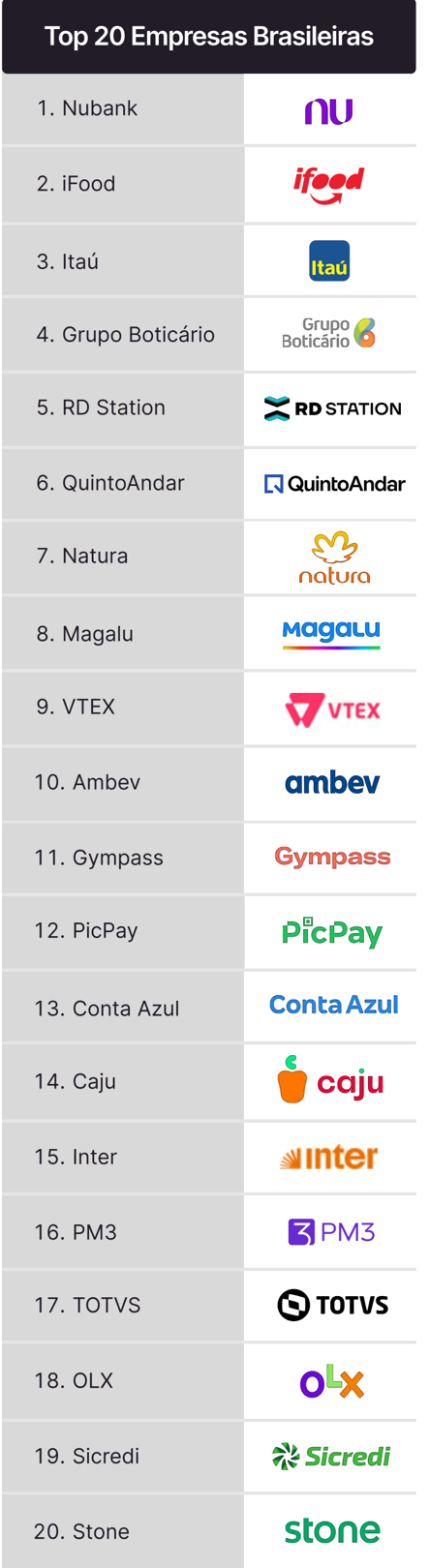
"Product Market Overview 2024-2025" by PM3 and Bain & Company.
Key takeaways
Leaders navigate a small world of digital businesses.
The flow of leaders (CTOs and CEOs) of digital companies is dominated by a closed circuit of companies such as: Nubank, Rappi, Mercado Libre, iFood, Loft, 99 and Loggi.
These companies occupy key positions in attracting executives who bring knowledge, best practices, and management models specific to digital companies, thus attracting greater investments.
Isolated clusters result in a weak network.
There are several groups of digital companies disconnected from the mainstream circuit, revealing a network that is not very cohesive or dense, which indicates a clear challenge for the development of the Brazilian innovation ecosystem.
Leadership profile
- Gender: Only 6% of the 290 are women.
- Unicorns: 12% have worked or are currently working for a unicorn.
- Training:
- 10% FGV, 7% USP, 6% Insper.
- 28% Engineering / Computer Science, 10% Economics, 10% Business Administration.
What is the main challenge for the digital innovation network in Brazil?
The results of this mapping indicate the need to encourage diverse connections between companies and executives, "breaking through the bubble" of the closed circuit of digital natives through which the main leaders circulate and creating strategic bridges with digital companies and those in the process of digitization to expand the business ecosystem.
Garcia Ignacio
Digital Anthropologist and CEO of AI Network Thinking
Want to know how network mapping can accelerate your organization's growth?
Talk to me directly!

We help you map and develop your strategic networks!
Mapping External Networks
Mapping and strategic positioning service within external stakeholder networks.